Imagine realizing that everything you consider your life—your hard-earned degree, your career, your social standing, and the expectations of everyone around you—is merely an immersive virtual reality headset you forgot you were wearing.
In late 2022, Ibrahim Mkunzi, a software engineer living in Nairobi, decided to take off the headset. He walked away from a lucrative tech path, stepped away from formal university structures, and plunged into the unknown to uncover his truest self. While modern society often misinterprets such abrupt departures as a psychological breakdown, tracing Ibrahim's journey reveals an undeniable breakthrough—one that laid the foundation for Betapsyche, an organization dedicated to healing the human psyche and mapping existential transformation.
Through the lens of Ibrahim's personal dream journals and revelations, we explore the science and spirit behind consciousness, the mechanics of the ego, and what it truly means to wake up.
1. The Nested Dream: Beta Testing Reality
The journey inward begins in a journal entry titled Insights Beyond the Surface. In this dream, Ibrahim finds himself inside a nested dream—a dream within a dream. He encounters a friend and, aware of his own state, tells this friend directly that their shared environment is an illusion.
In depth psychology and neuroscience, this friend is not a separate entity; the character is a localized projection of Ibrahim’s own unconscious mind. During REM sleep, the brain functions like a closed-loop virtual machine. When Ibrahim speaks to his friend, the conscious mind is literally attempting to communicate with its own compartmentalized layers.
Why run a simulation inside a simulation? Because the brain is a prediction engine designed to maintain stability. If the raw, unfiltered reality of non-duality were dumped directly into waking life, the shock could be overwhelming. The nested dream structure allows the psyche to "beta test" ego dissolution safely in a quarantined mental space.
Yet, even with lucid awareness, Ibrahim does not manipulate the dreamscape or force himself awake. This highlights a crucial truth: cognitive awareness is not the same as experiential liberation. Recognizing the illusion is easy; fully escaping it requires surrendering the ego's desire to control the outcome.
2. The Weight of Expectations and the Somatic Crucible
When logic fails to keep the waking mind contained, the ego deploys brute force. In a subsequent entry titled The Scariness to Dream, Ibrahim documents an agonizing experience of sleep paralysis. Objects pile relentlessly onto his chest until he is completely immobilized. When he undergoes a false awakening, his family surrounds him—convinced his terror is merely the onset of a physical illness or flu.
This dream mirrors the intense biological friction of walking away from tribal safety. For hundreds of thousands of years, abandoning the tribe's accepted path meant exile and death. When Ibrahim abandoned the conventional milestones of prestige and salary, the primitive regions of his brain interpreted the move as an existential threat.
The heavy objects on his chest were the physical manifestations of cognitive load—every expectation of what a successful young man should be in modern society. Furthermore, his family's reaction reflects society's "containment strategy": when culture lacks the vocabulary for spiritual emergence, it pathologizes the experience as a disease to be managed rather than an evolution to be understood.
3. Einstein and the Optical Delusion of Consciousness
To bridge the chasm between deterministic engineering and deep mysticism, Ibrahim's unconscious summoned an unexpected guide: Albert Einstein.
In The Einstein Dream, the father of modern physics appears not as a cold academic, but as the ultimate symbol of synthesis. Einstein famously utilized deterministic mathematics to prove that reality is observer-dependent and relative. In his writings, Einstein noted:
"A human being is part of a whole called by us the universe. He experiences himself, his thoughts, and feelings as something separated from the rest, kind of optical delusion of his consciousness."
Modern neuroscience connects this "optical delusion" to the brain's Default Mode Network (DMN)—the neural circuit responsible for self-referential thought, past-future projection, and maintaining the boundary between "me" and "not-me". While essential for basic biological survival, the DMN creates an internal prison when it convinces us we are fundamentally isolated fragments.
Einstein’s presence served as an instruction manual: the analytical mind does not need to be destroyed; it must be integrated and elevated into a wider field of awareness.
Moving from the Head to the Body
Intellectualizing freedom is the ultimate trap. You can memorize quantum mechanics, study neural pathways, and quote philosophical treatises, but that knowledge remains confined to the prefrontal cortex. Knowing the exact metallurgical composition of your prison bars does not open the cell door.
To dismantle the illusion, understanding must become somatic—it must move from the head down into the central nervous system. The journey across the threshold demands enduring the crucible where the old identity burns away.
When the drop of water realizes it is not separate, it does not vanish. It becomes the ocean.
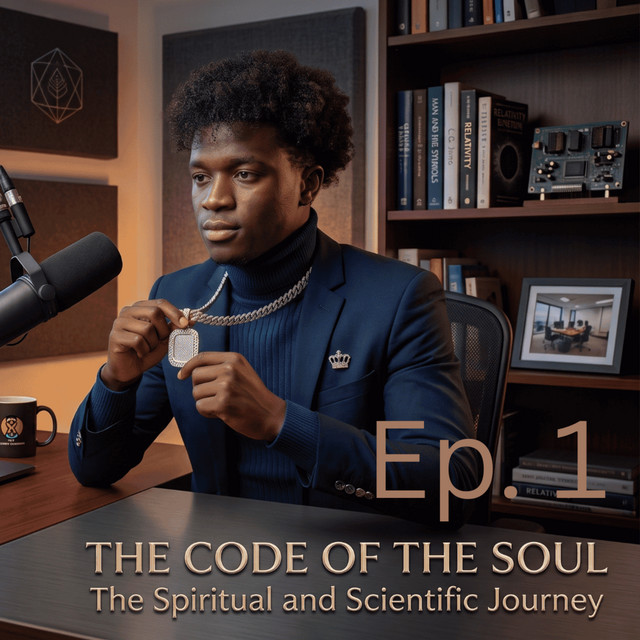
Listen to the whole podcast on Spotify!