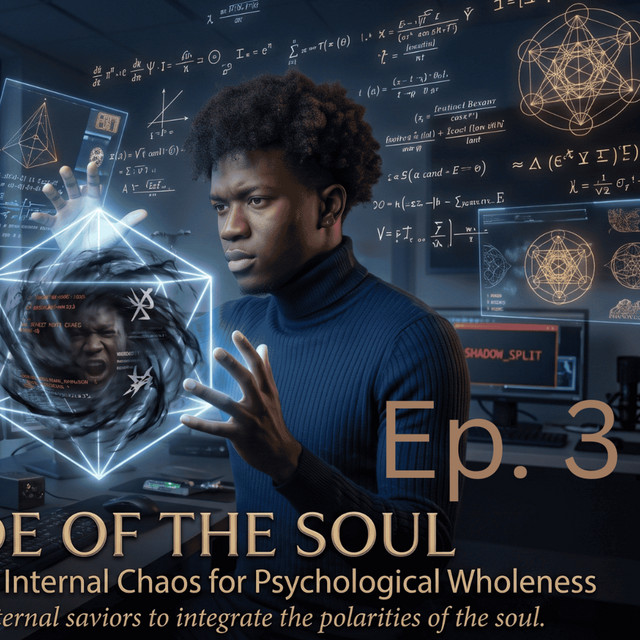
Imagine waking up in pitch blackness wrapped in a profound sense of spiritual serenity, only to have a massive beast pounce directly onto your face and pin you to your bed, stealing your breath.
This terrifying scene is not a horror script—it is the literal starting point of an internal initiation documented in the revelation journals of Ibrahim Mkunzi. While early spiritual breakthroughs often reveal expansive symbols like cosmic mandalas or the unblinking eye of pure awareness, observing symbols is merely reading the map. Walking the actual territory requires navigating treacherous internal terrain, confronting our darkest impulses, and meeting the psychological archetypes that guide us toward genuine integration.
Tracing three pivotal journal entries—The Dark Night of the Soul (May 26), The Big Calling (August 10), and A Philosopher Called Jesus and the Wise Woman (May 22)—reveals how an untamed nightmare can transform into the engine of psychological liberation.
1. The Ambush of the Shadow: Why Forced Purity Backfires
In The Dark Night of the Soul, Ibrahim experiences an overwhelming sense of oneness and vital purpose. Yet, at the exact peak of this spiritual high, the power in his physical room suddenly cuts out—a striking instance of synchronicity, where an external event mirrors an internal psychological transition.
As he drifts to sleep in the dark, the blissful state vanishes, replaced by a dream of human tragedy. Suddenly, a large cat-like beast pounces onto his face, pinning him down and suffocating him.
[Forced Ascent into Light & Oneness]
                 │
                 ▼ (Activates Equal Opposite Force)
[Eruption of the Repressed Shadow: The Breath-Stealing Beast]
In ancient languages, breath shares its root with spirit (pneuma in Greek, ruach in Hebrew, prana in Sanskrit). By stealing his breath, the unconscious mind delivers a non-negotiable message: you cannot bypass the animalistic, primal layers of the self to reach the divine.
When the conscious mind reaches aggressively toward artificial purity, it casts an equally dark shadow. The unintegrated, repressed instincts do not disappear; they violently assert themselves to restore equilibrium. Ibrahim halts the attack by reciting a short prayer, exerting an internal locus of control and establishing a vital boundary. Yet, while a prayer can banish a night terror temporarily, shadow energy cannot be destroyed—it must eventually be understood and integrated.
2. The Illusion of External Saviors: The Tunnel and the Church
In the August 10 entry, The Big Calling, the inner landscape scales from a private bedroom to a massive societal vista. Ibrahim finds himself at the exit of a congested road tunnel where trapped crowds are bottlenecked in misery:
The Politician: A political leader attempts to pull the crowd forward with promises of worldly hope, but the hope proves empty and fails to move the masses.
The Prophet: A religious prophet brings out formerly incarcerated individuals to testify to their freedom, yet Ibrahim notices they are still wearing their prison uniforms—signifying superficial liberation where internal reality remains caged.
Horizontal Movement: Stuck in traffic jam ---> Trading worldly hope for religious dogma
                                               (Still wearing prison uniforms)
Vertical Ascent:     Climbing the stairs  ---> Detached, hyper-lucid 4K awareness
Recognizing the futility of horizontal solutions, Ibrahim ascends a high staircase, recording the scene with the detached, objective clarity of a 4K camera.
On these stairs, he encounters Carl Jung, the father of analytical psychology. When Ibrahim’s twin-like brother—representing the part of the psyche tempted by easy dogmatic escapes—attempts to enter a nearby church, Jung acts as a guardian, warning him away. Jung’s presence signals that institutional dogmas often act as another uniform, externalizing salvation rather than doing the arduous, solitary psychological work required within.
3. Enantiodromia: The Chaotic but Ultimate Solution
Jung guides the way but stays behind; Ibrahim must reach the summit alone. At the peak of the staircase, overlooking the trapped masses and external leaders, Ibrahim performs his "biggest calling".
He does not deliver a speech or write a manifesto. Instead, he presents two cats—one on his left and one on his right—holding them up to face each other as he prays over them.
Single Shadow Cat (May 26) | Two Facing Cats (August 10) |
Uncontrolled, violent night terror | Duplicated, harnessed, and balanced forces |
Attacks the face and suffocates breath | Held in conscious tension through focused will |
Primitive instinct repressing the conscious mind | Enantiodromia: Active integration of polarities |
This act visually embodies enantiodromia—the principle that superabundance of any force inevitably produces its opposite. The left and right cats represent the core dualities of human existence: light and dark, conscious and unconscious, intellect and animal instinct.
Ibrahim terms this balance a "chaotic but ultimate solution" to human suffering. Wholeness is not passive, tranquil peace; it is a high-wire act requiring immense concentration to force opposing aspects of the self to look at one another without letting either consume the other.
4. The Core Diagnosis: Attachment
To sustain this dynamic equilibrium, the mind requires a foundational philosophy. In the May 22 encounter, A Philosopher Called Jesus and the Wise Woman, Ibrahim stands alongside a mature female executive (a wise woman archetype) in the presence of Jesus—appearing strictly as an archetypal philosopher rather than a dogmatic religious icon.
When Ibrahim asks about the state of the human psyche, a single diagnosis cuts through the silence: Attachment.
Suffering stems from clinging to ego identities, rigid outcomes, and external saviors. The crowds in the tunnel suffer because they are attached to worldly promises; the individual suffers because they cling to an idealized self-image while repressing their shadow. The moment you become attached to one side of the polarity, you lose the tension, drop the cats, and tumble back down into the collective bottleneck.
Driving the Vehicle
The dark labyrinth of transformation is not designed to destroy you. The shadow monster hunting you in the dark contains the very vitality and instinct needed to power your growth. True psychological maturity demands that we stop projecting our salvation onto external systems, sit courageously with our internal polarities, and master the chaotic tension of holding our light and darkness in unified balance.
Listen to the whole podcast on Spotify!