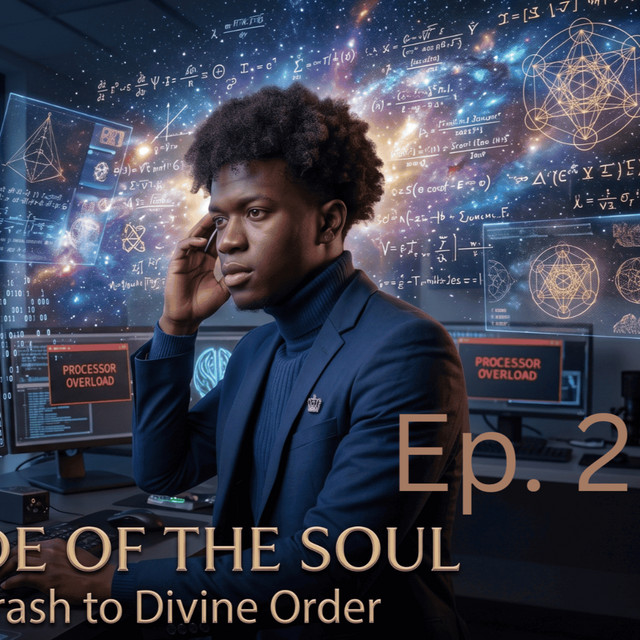
Imagine your brain as a high-performance computer processor suddenly forced to download the entirety of the cosmos in a single millisecond. The cooling fans whir out of control, the hardware overheats, the display glitches, and the foundational operating system you rely on to define your identity threatens to completely collapse. This is not a subtle glitch; it is a full, catastrophic system reboot. By its very nature, a reboot demands that the entire system shut down, plunging into total darkness before any new light can emerge.
Spiritual awakening is rarely the gentle, serene experience depicted on wellness blogs. It is not merely sitting peacefully on a yoga mat. True awakening often feels like the sky being violently ripped open.
Intellectually recognizing Albert Einstein’s observation that our individuality is an "optical delusion of separation" is only a preliminary step. Grasping a concept in your prefrontal cortex does not melt the iron bars of the ego's cell. The ego—the psychological construct insisting on rigid boundaries between self and other—will fight to maintain its territory.
When those borders are forcibly dismantled, the individual enters what depth psychology calls phenomenological transit: the raw, direct, first-person experience of consciousness shifting its structural reality.
Drawing from the August 2023 revelation journals of Ibrahim Mkunzi—a Nairobi software engineer who walked away from deterministic logic to explore the nature of the mind—we break down the universal journey from terrifying chaos to divine order.
1. The Velocity of Infinity: When Hardware Meets Boundless Software
In a journal entry titled An Overwhelming Initiation (Fleeting Glimpse of Infinity), Ibrahim documents moving through cosmic space at velocities that are virtually impossible to perceive.
The human nervous system evolved to track terrestrial speeds essential for immediate physical survival—such as a running predator or an incoming hazard. It was never wired to compute the limitless speed of infinity. When internal transit exceeds cognitive bandwidth, the mind encounters the outer boundary of its own architecture.
[Dualistic Ego]       ---> Requires Space, Time, and Boundaries
       |
[Non-Dual Transit]    ---> Obliterates Coordinates (No Zip Code, No Calendar)
       |
[Ego Response]        ---> Interprets Dissolution as Biological Death
In this non-dual state, the ego loses all its traditional coordinates: the past to regret, the future to plan for, and the localized position in space that says "I am here and not there". Because the ego requires separation to exist, the dissolution of these boundaries triggers sheer existential panic. The mind feels as though it is physically dying, even while anchored by the lucid awareness that it is inside a dream.
Yet, this experience is fundamentally distinct from a psychological breakdown. While clinical panic traps a person inside isolation and paranoia, this transit carries an underlying sense of returning to a deeply familiar home. Waking up in intense tears is not the terror of fright; it is the aesthetic arrest of the soul weeping as it is squeezed back into the narrow container of the physical body.
2. Facing the Shadow: The Munganga and the Rubber Smartphone
When the mind resists dissolution in the abstract void of outer space, the unconscious shifts the battlefield to familiar territory. In The First Eye-Opening Experience, Ibrahim is guided by his father into an old house toward a munganga's (traditional healer's) corner filled with pottery, beads, and spiritual artifacts.
In East African cultural history, traditional healers were demonized during colonial eras and pushed into the cultural shadow—associated with the unseen, the occult, and deep fear. In analytical psychology, the shadow represents everything the rational, modern ego suppresses to function in society. Rather than retreating in fear, Ibrahim consciously submits to the space, melting into the floor like a feather and descending directly into the unconscious.
What follows is a false awakening that deconstructs the symbols of modern stability:
The Malleable Smartphone: Ibrahim looks at his smartphone—the ultimate symbol of logic, connectivity, and modern reality—and finds it snapped in two yet completely bendable like rubber, though the screen remains lit. The rigid rules of linear logic begin to melt.
The Blackout: Attempting to use the phone to purchase power tokens and restore light to the room, he finds he cannot enter his PIN. The room plunges into total darkness, severing the ego's control.
The Core Anchor: As he is swallowed by the void, Ibrahim shouts the name of his nonprofit, Betapsyche. When all external accomplishments and rational structures are stripped away, the only anchor that remains is a core purpose rooted in service to others.
3. The Unblinking Gaze: Confronting the Eye of Providence
As the transit accelerates, the experience becomes viscerally physical. Time alternates between a crawl and extreme speed, and Ibrahim begins to physically lose his breath. The nervous system interprets psychic dissolution as biological asphyxiation.
At the climax of this darkness, the Eye of Providence appears, staring directly at him.
Popular Culture Interpretation | Archetypal / Psychological Reality |
Surveillance, conspiracies, and external control | The omniscient, unblinking witness of the universe |
Paranoia and fear of external forces | Pure, undiluted awareness looking directly back at consciousness |
An oppressive entity | The complete vaporization of ego privacy and separation |
The terror of the single eye is not due to malice; it stems from the ego realizing it has nowhere left to hide. The masks, defenses, and secrets that protect the separate identity are entirely vaporized under the unblinking gaze of pure awareness.
4. The Mandala: How Chaos Resolves into Divine Order
Nature abhors a vacuum, and consciousness does not leave the psyche in perpetual fragmentation. Immediately following the terror of the single eye, Ibrahim enters a second dream state where the darkness gives way to light.
Above him weaves an intricate, moving geometric pattern—resembling a cathedral’s rose window—accompanied by an audible voice speaking the single word: "Heaven".
This geometric form is a mandala, an ancient archetypal pattern representing psychic wholeness, balance, and the integration of opposites. The movement from the dark void to the mandala mirrors the physical science of cymatics (the visualization of sound frequencies through sand on a metal plate):
[Stable Old Frequency]
         │
         ▼
[Frequency Shift: Total Chaotic Disarray]  <-- The Void, Suffocation, The Eye
         │
         ▼
[New Resonance: Elegant Symmetrical Form]  <-- The Rose Window, Harmony, "Heaven"
The terrifying void was never empty; it was pregnant with higher order. The old pattern had to be completely disrupted before the higher symmetry could take form.
Enduring the Transit
The blueprint of this transformation applies directly to waking life. Deep personal growth rarely occurs during periods of comfort. When a career collapses, a long-term relationship dissolves, or a cherished worldview shatters, our modern "smartphones" bend and our lights go out.
In those moments of acute vulnerability and breathlessness, the instinct is to panic and prematurely rebuild the old, broken structures. But true transformation requires holding on to core purpose, allowing the old framework to stay broken, and enduring the dark night until consciousness naturally snaps into a wider, more integrated wholeness.
Listen to the whole podcast on Spotify!